Dubai's interior design market evolves fast. What dominated showrooms three years ago often looks dated today. For wood flooring specifically, 2026 has seen a decisive move away from grey-washed, heavily distressed looks towards natural, warm, and architecturally confident formats. Here's what's trending — and what's fading.
1. Wide Plank — The Dominant Format
The most significant shift in Dubai's wood flooring market is the continued growth of extra-wide planks. Where 120–150mm was considered wide five years ago, today's premium projects routinely specify planks of 180mm, 220mm, or even 300mm+ in bespoke engineered oak.
Wide planks create an immediate sense of space and luxury — critical in Dubai's villa market where interior dimensions are generous and narrow planks look visually cluttered. They also showcase the natural grain and character of the wood species far better than narrow-strip formats.
Recommended species for wide planks: European white oak, American black walnut, ash
2. Herringbone and Chevron Parquet — Still Growing
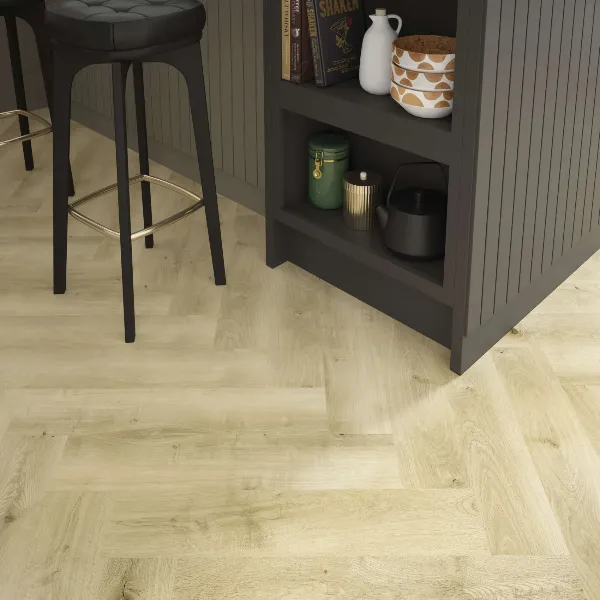
Herringbone parquet has been growing in Dubai since 2021 and shows no sign of peaking. The pattern adds architectural complexity to otherwise minimal interiors and photographs extraordinarily well — a consideration that genuinely influences purchasing decisions in Dubai's villa market.
The key distinction for 2026 is scale. Micro-herringbone (small blocks, tight pattern) dominated early adopters; the current preference is for larger-format herringbone (individual pieces 90mm × 600mm+) which reads as more contemporary and less traditional.
Chevron — where the planks meet at a point rather than a step — is growing in appeal for its cleaner, more graphic appearance.
3. Smoked and Fumed Oak — The Statement Finish
Fumed oak (where ammonia vapour reacts with the tannins in the wood to produce a rich, deep brown tone) and smoked oak have become the prestige finish of choice for Dubai's high-end villa and penthouse market. The colour range from honey-brown to deep espresso is impossible to replicate in vinyl or laminate, which is part of its appeal.
Smoked oak pairs exceptionally well with raw concrete, brushed steel, and linen-palette interiors — exactly the aesthetic direction of Dubai's premium residential projects right now.
4. Natural and Unfinished Looks — The Wellness Aesthetic
There is a strong move toward floors that look natural and minimally processed — matte oil finishes rather than lacquer, visible grain texture, and wood species left closer to their natural colour rather than stained. This connects to broader wellness and biophilic design trends highly relevant to Dubai's post-pandemic market.
Light French oak with a hardwax-oil finish is the defining product of this trend: warm, natural, tactile, and easy to maintain.
5. What's Declining in 2026
- Grey-washed finishes — heavily popular 2018–2022, now looking dated; giving way to warmer tones
- Heavily distressed, hand-scraped textures — oversaturated in the market
- Narrow strip (65–90mm) straight-lay — being replaced by wider planks
- High-gloss lacquer finishes — showing scratches and footprints too readily
Choosing Engineered vs Solid in Dubai
For Dubai specifically, engineered hardwood is strongly preferred over solid hardwood for almost all applications:
- Dubai's central air conditioning creates extreme humidity differentials between summer (very dry indoors) and winter (more humid)
- Engineered wood's cross-bonded plywood core limits expansion and contraction to a fraction of solid wood's movement
- Herringbone and wide-plank patterns create significant internal stresses that engineered construction handles far better
- Most premium European brands now focus their best designs on engineered products
Installation Considerations for Dubai
Wood flooring in Dubai performs best when:
- Indoor temperature is maintained between 18–28°C year-round (normal air conditioning achieves this)
- Humidity is maintained between 40–60% RH — use a humidifier in winter months if possible
- Subfloor is level (within 3mm per 2m), dry, and clean
- Expansion gaps of 10–15mm are maintained at all fixed objects and walls
- Direct sunlight exposure is managed with UV-filtering glazing where possible